Inside Sonder Festival: DIMA & GiGi and the Art of the Perfect Set
Written by Sofia Perica
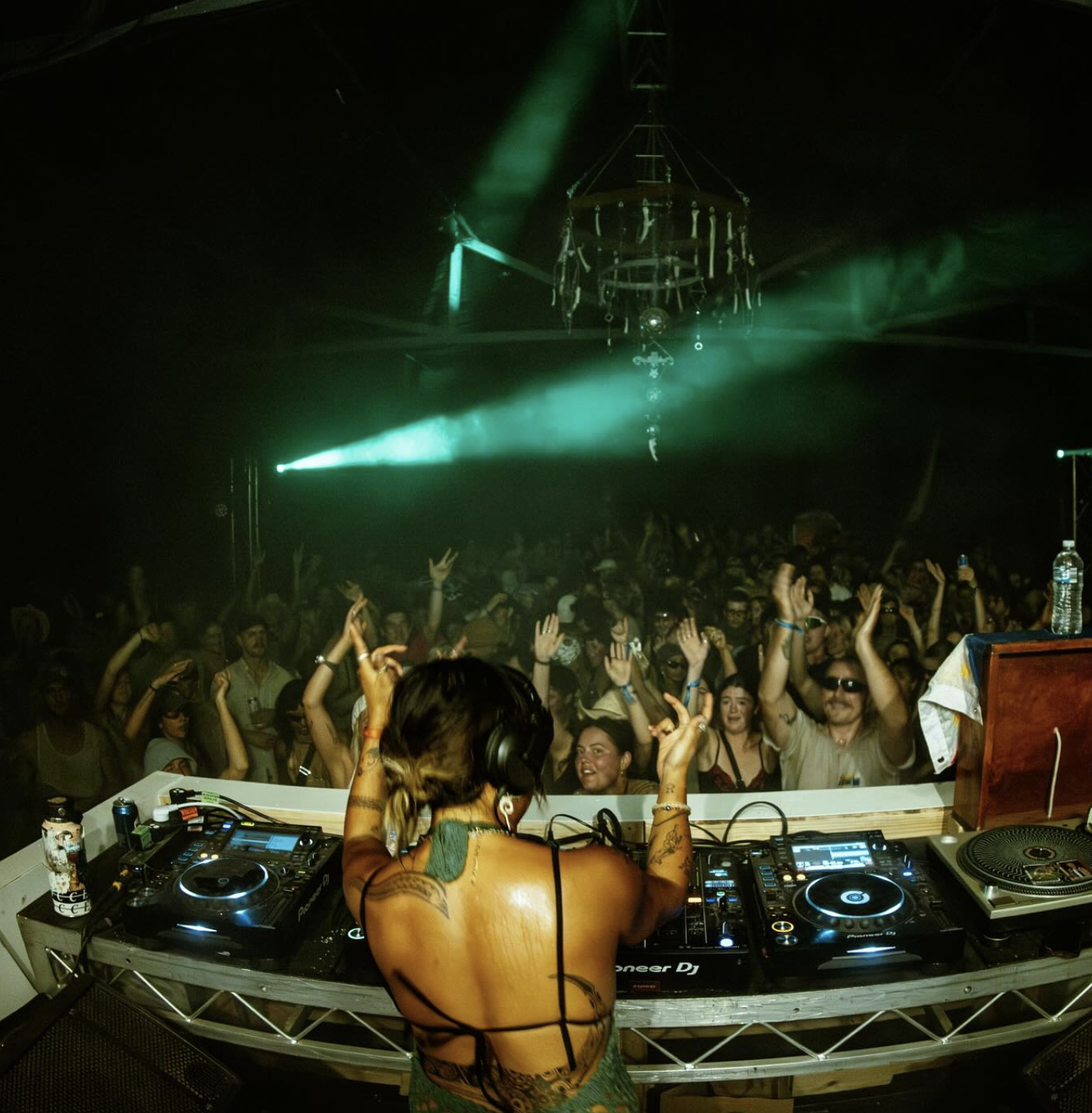
Rising from Mparntwe/Alice Springs to the stage at Sonder Festival, DIMA and GiGi bring more than just a DJ set, but rather a community with them.
Sitting down with them after their sets at Sonder, it becomes clear pretty quickly that what they’re chasing is something harder to define and way more instinctive.
When asked how she’d describe her sound, GiGi laughs. “It’s so hard to say,” she admits. “I don’t want to go into genres because I’m really bad at describing it like that. I’d say it’s progressive, tribal, psytrance, but I also mix in house and bass music. Lots of snippets because I want to tell a story. It’s very bass heavy, more prolonged sound… like building it out and then a heavy drop.”
DIMA cuts in with something simpler but just as telling. “Super dancey,” she says. “Bumpy. Comfy and euphoric at the same time.” She pauses, then adds, “It goes across heaps of genres.”
GiGi grins and sums it up in her own way. “Dirty, skanky bass.”
What they’re both getting at is more about feeling. For GiGi, DJing is ultimately a form of communication. “It’s my way of connecting,” she says. “It’s self expression. It’s like being able to talk to people through music.”
That connection shifts depending on where they’re playing, but nowhere more so than at Sonder. For both of them, the festival feels personal in a way bigger events don’t.
“This is my favourite festival because it’s all my friends,” GiGi says. “Childhood friends.”
DIMA agrees. “Looking down and seeing my friends, that’s just special in itself,” she says. “Having a bunch of other people there is just an addition. People chose to be here. It’s such good vibes, you don’t have to worry about the people around you.”
That sense of familiarity shapes how GiGi approaches her sets. “With Sonder, it’s a lot of friends that I’m playing for,” she explains. “So I feel like I’m doing references for them, using memories with friends. It’s more communal.”
It’s a very different energy to the scale of festivals like Dark Mofo or Strawberry Fields Festival, both of which they’ve played.
“That was so nerve wracking,” DIMA says of opening the main stage at Strawberry Fields. “We were playing in front of like 15,000 people. Having my mate there helped calm the nerves, but yeah… it’s a lot.”
Even as their profiles grow, both keep coming back to smaller, community-driven spaces like Sonder, where the line between DJ and crowd feels almost nonexistent.
Both artists grew up in Mparntwe/Alice Springs, and that environment has quietly shaped their sound. “There’s a lot of doof culture in Alice Springs,” GiGi says. “So much outback.” She pauses, then adds, “I use a lot of that in my sounds. Indigenous sounds, and also being Filipino.”
Her relationship to that Filipino identity has shifted over time. “I moved to Australia when I was seven, so I just wanted to be Australian,” she says. “But now I’m like, it’s actually sick to be Filipino. I’m finding more artists I resonate with, exploring old sounds, old instruments, tribal sounds.”
For DIMA, place shows up more in the feeling than anything explicit, in the looseness of his sets and the way they move without restriction.
That same openness carries into their production work. DIMA’s track You and I marked an important shift for her creatively. “It was made with one of my best mates,” she says. “It’s really personal, but it also feels like the start of actually putting things out.”
Letting go of perfectionism has been part of that process. “You could work on it forever,” she says. “At some point you just have to stop rinsing it out.”
Working with friends has made that easier. “It just makes the process so fun,” she adds. “You’re bouncing off each other’s energy. It’s like your world together.”
GiGi is in a similar place, currently working on a collaboration with Alex Coffee. “He’s so talented,” she says. “That should be coming out in the next few months.”
When it comes to performing, though, she’s learned that mindset matters just as much as preparation. “The worst sets I’ve played are when I’ve been too in my head,” she says. “Worried about everything else and making people happy.”
The best ones are the opposite. “When I’m locked in, in my own zone, not even looking at anything, just doing it for myself… that’s the best time. When you’re present, you just tune in.”
As a woman in a still male dominated scene, both are also aware of the shifts happening around them. “We’re creating a platform for female DJs,” GiGi says. “They’re getting the rep they deserve now.”
She struggles to define exactly what feels different, but knows it when she sees it. “It’s a different energy,” she says. “You can be playing the same genre as someone else, but it just feels different.”
And when she sees that reflected back at her from the crowd, it matters. “When I’m dancing and I look up and see a female DJ doing her thing, I’m like yes. Spotlight on you. You deserve that.”
At Sonder, all of these elements come together in a way that feels effortless but is anything but. The storytelling, the friendships, the cultural influences, the instinct to let go rather than overthink it. It all collapses into something shared.
Or, as DIMA puts it more simply, “the best, yummy, dancey festival music.”